
Tarot Journal: two readings, and *a vote on which was right*
My private tarot journal: the app and Claude both read the cards, and my vote for the more accurate one trains the app.

Andrew Firth
Director
·
November 25, 2026
·
5 min read
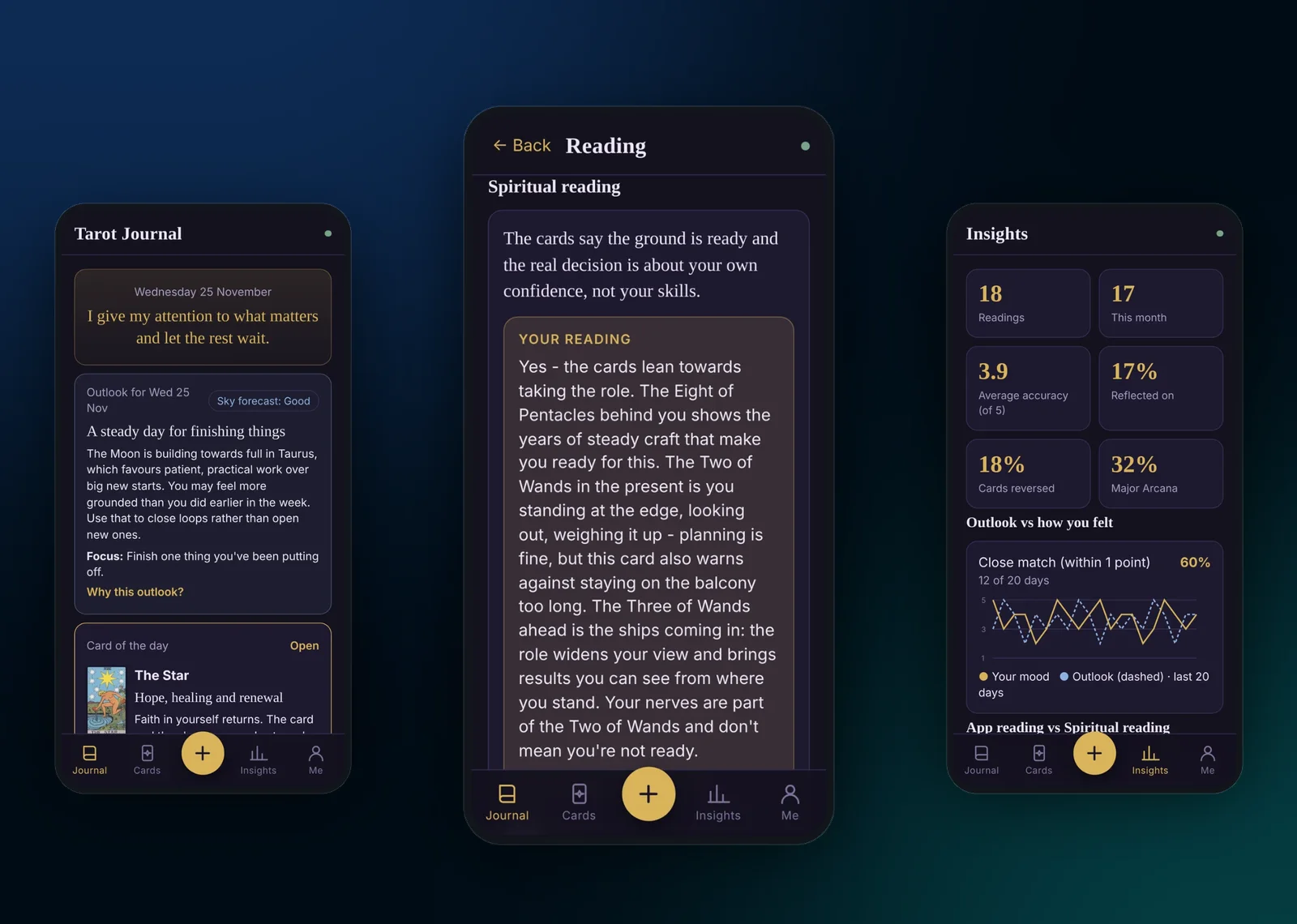
This started as a personal project. I like turning tarot cards to get my mind working and to take whatever insights I can from them, and they can be surprisingly accurate at times.
Tarot Journal is a private tarot app I built for myself and a small circle of invited family and friends. It's a progressive web app (PWA), so it installs on the phone home screen from the browser and runs like an app, with no App Store listing behind it.
It isn't a public product. There's no sign-up page, and nobody can download it from a store or create an account on their own. Each person joins through a single-use invite link that I send them, and that link expires after seven days.
I also designed it to help me learn the cards. After each deal I write my own interpretation first, then the spiritual reading gives me feedback on it: what I caught, and any card I skipped or gave too much weight to. Every reading also explains what each card means in its position and why, so I'm picking up a little more about the meanings each day.
It's an AI lab too. I wanted to see whether a rules-based engine running on the phone, at no cost per use, could read the cards as well as a large language model. Every reading gets both, and I vote on which one was more accurate. Those votes are there to train the app's own reading engine.
What the app does
I deal real cards at the table, then log the reading on my phone: the question, the spread, each card and whether it came up reversed. The app then reads the cards twice.
- App reading: an engine on the phone writes the reading from rules and a hand-checked library covering all 78 cards, upright and reversed. No AI service is involved and each reading costs nothing.
- Spiritual reading: Claude, Anthropic's AI, writes a fuller reading that answers the question first, then walks through each card, how they combine, the person's own interpretation and patterns across their history. Every one is labelled as written by Claude.

Then I vote on which reading was more accurate: App reading, Spiritual reading or About the same. The vote is there to train the app. It shows me which cards, spreads and situations the engine reads well and where its rules need more work, so each round of changes is aimed at the readings it lost.
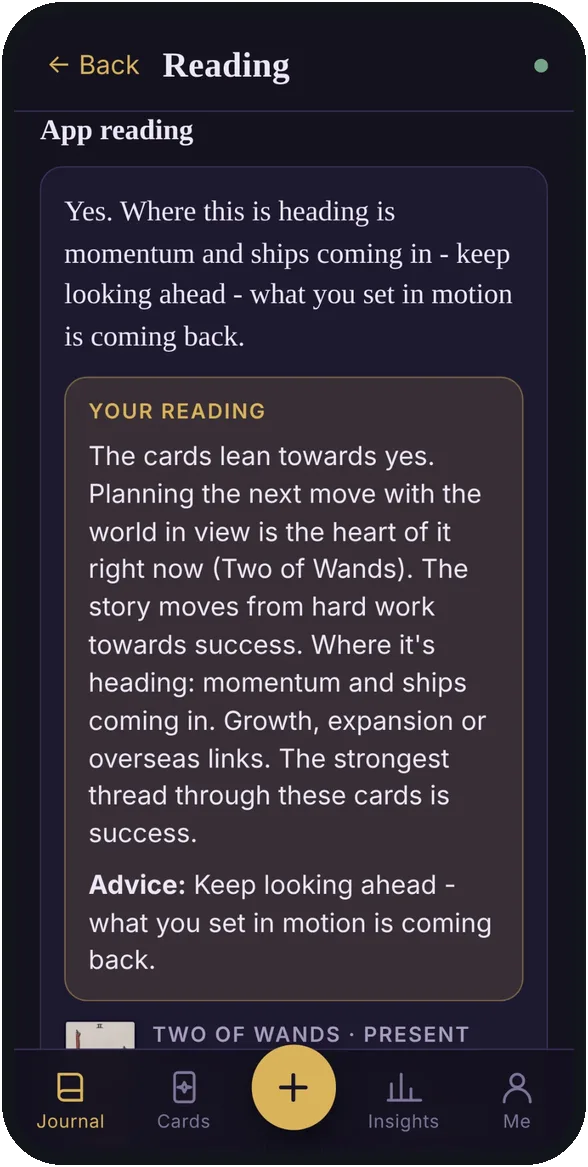
Around that core, the app also:
- Suggests a spread and topic from how the question is worded, for example Option A or B for a choice between two paths. This runs on the phone and uses no AI.
- Builds a daily outlook from each person's birth chart and the day's sky. Planet positions are calculated on the server and Claude only writes the words, so it never has to guess where a planet is.
- Shows a daily affirmation and a card of the day, and sends an optional morning notification.
- Schedules check-ins based on how far ahead the question looks (tonight, three days, two weeks, a month or the long term), then asks "Is it moving the way the cards suggested?"
- Turns those check-ins into accuracy figures in Insights, and compares the outlook with the mood people log each day.
- Includes a card library with all 78 cards, using the original 1909 Rider-Waite-Smith artwork by Pamela Colman Smith, which is in the public domain. Each card page covers the upright and reversed meanings, the imagery, the number and the astrology, and every card in a reading links straight to its page, which is how I'm learning them.

Privacy is strict. Each person sees only their own readings. Someone can share their daily outlook headline with the people they tick, but their readings are never shared. As admin I can see usage numbers and nobody's readings.
How I built it
The first version went live on 29 October 2026. It was a static app that kept its data on the phone. Over the next week I added accounts, sync, the two readings, astrology and check-ins. I directed the build and Claude wrote the code, working session by session against a running log of locked decisions so nothing got re-argued.
Tech stack
- Front end Plain HTML, CSS and JavaScript PWA with a service worker, served by nginx
- API FastAPI (Python) on a DigitalOcean droplet, SQLite with nightly backups
- Sign-in Passkeys (WebAuthn) and single-use invite links. No passwords
- AI Claude Sonnet 5.5 for spiritual readings and follow-up chat, Claude Haiku 5.5 for the daily outlook and affirmation
- Astrology astronomy-engine, calculated on the server
- Notifications Web push with VAPID keys
- App reading engine JavaScript on the phone, plus a card library written in Claude chat sessions and checked by hand
Cost was a design constraint from the start. Spiritual readings only run when someone presses the button, never automatically. Each person has a monthly allowance (60 readings and 100 follow-up messages by default) and token use is logged on every call. The outlook uses the lighter model and is cached once per person per day.
What I learned
- Phones don't always render the way the spec says. Android Chrome on my phone drew the page about 980px wide, the way it would draw a desktop site. I fixed it by working out the real screen width in code and scaling the app to match, rather than fighting the viewport settings.
- Push subscriptions expire without telling you. Notifications stopped arriving with no error on either side. The app now re-registers every time it opens.
- Long AI answers outlast a web request. A 10-card Celtic Cross reading can take minutes, longer than a phone or proxy will hold a connection open. Readings now run as background jobs and the phone checks back until the result lands.
- People read visuals as being about them. The outlook first showed the day's forecast as a row of dots, and people took it for their own mood score. A plain label ("Sky forecast: Good") fixed it.
- Let the user be the judge. Asking for a vote on every reading gives me a running measure of where the free engine is good enough and where it isn't, which beats guessing.
What it could mean for your business
The pattern behind the app works well beyond tarot. A free rules engine handles everyday answers at no cost per use, an AI model handles the ones that need more depth, and the people using it vote on which did better. Every vote shows where the cheap engine is good enough and where the AI earns its cost.
For a business, that could be product recommendations, quote estimates or first-line support answers: rules where rules are good enough, AI where they aren't, and real data on which is which.
What's next
I'm keeping the app private to family and friends, with Claude writing the spiritual readings. The votes decide what I work on in the app's own engine next: more varied phrasing, readings for card pairs (The Tower with Death, for example) and timing hints. I'd only think about a wider release once the app reading matches or beats the spiritual reading most of the time, and I've no plans for one today.
Andrew Firth
Director
Ascensor
Questions this piece answers.
Want a view on your own business? Tell us what you are trying to achieve and we will tell you how we would approach it.
Talk to us
Is Tarot Journal available to download?
No. It's a private progressive web app for a small circle of invited family and friends. People join through a single-use invite link that expires after seven days, and there's no public sign-up or app store listing.
What's the difference between the app reading and the spiritual reading?
The app reading is written on the phone from rules and a hand-checked library of all 78 cards, at no cost per reading. The spiritual reading is written by Claude, Anthropic's AI, and only runs when someone asks for it.
Why vote on which reading was more accurate?
Each vote shows which cards, spreads and situations the free engine reads well and where its rules need work. Over time that tells us where rules are good enough and where the AI earns its cost.
How are AI costs kept under control?
Spiritual readings only run when someone presses the button. Each person has a monthly allowance, token use is logged on every call, and the daily outlook uses a lighter model and is cached once a day.
Want to know where AI *earns its cost?*
A few details is enough to start. We will reply to say how we would approach it.
Prefer to call? 0113 831 4400
More from the lab.
Tarot Journal: two readings, and *a vote on which was right*
My private tarot journal: the app and Claude both read the cards, and my vote for the more accurate one trains the app.
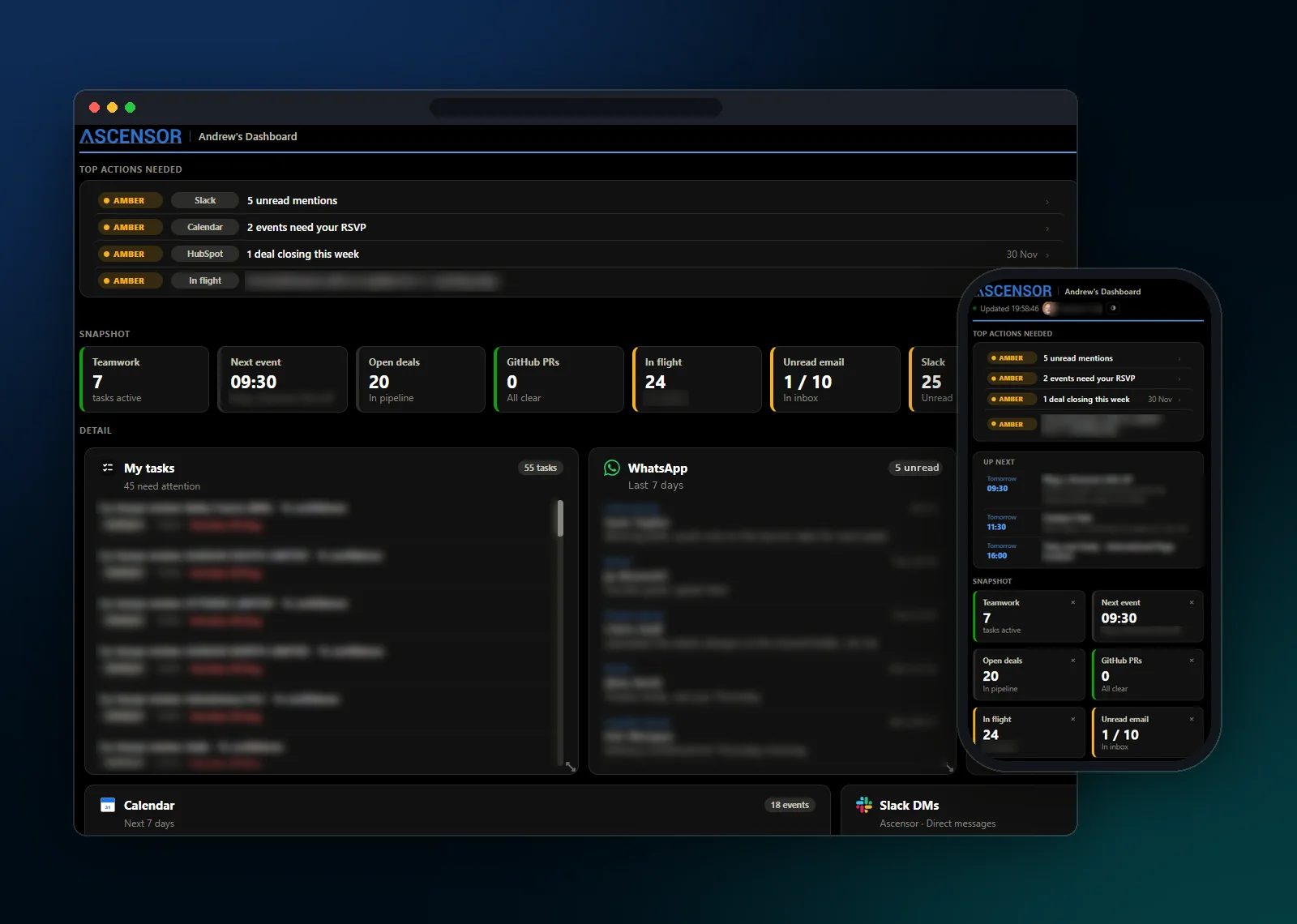
Team Dashboard: six systems, *one screen*
Email, calendar, Slack, HubSpot, Teamwork and GitHub all compete for our attention. So I built a dashboard that pulls them onto one page, shows what needs doing first and lets us clear it from there.
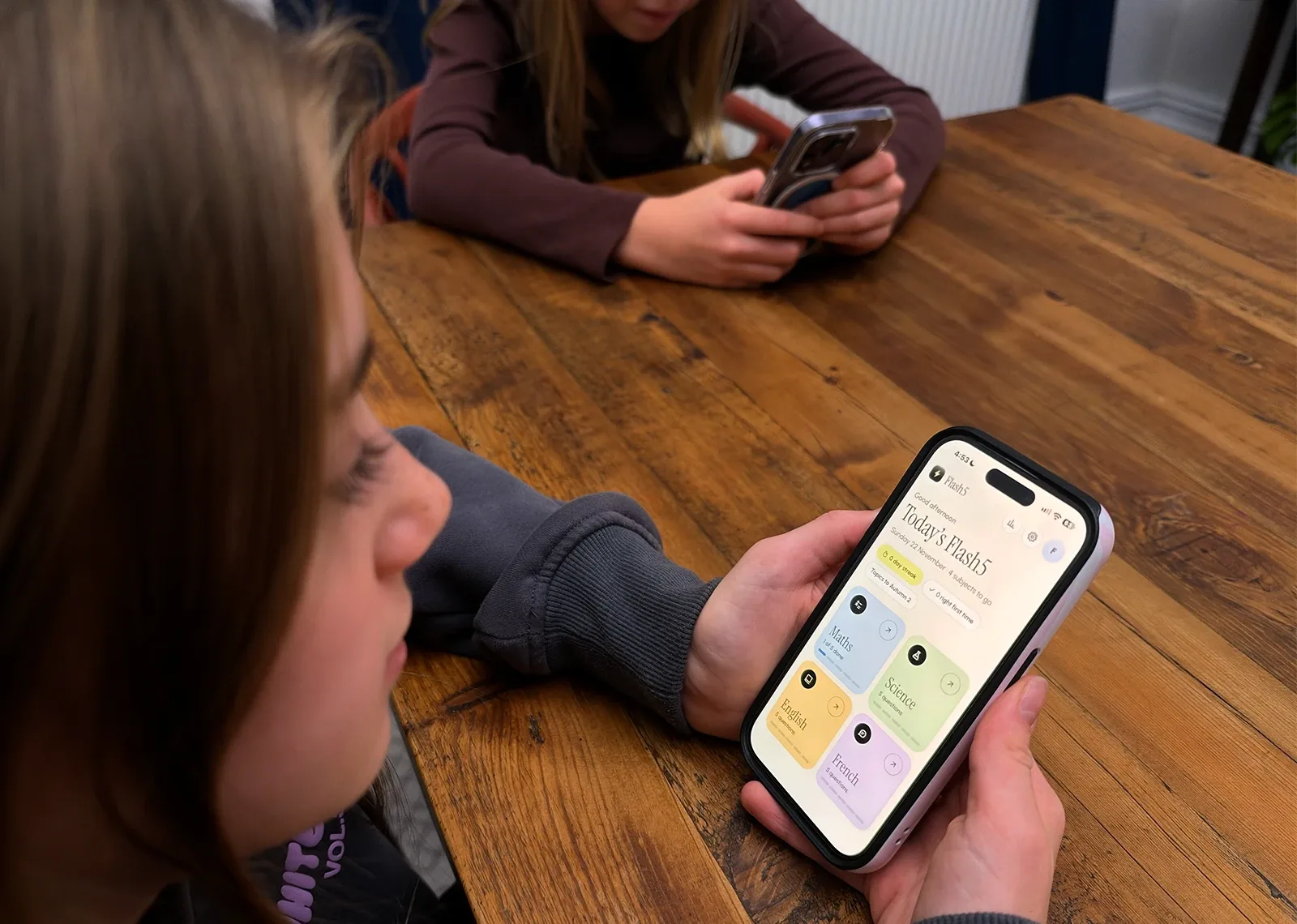
Flash5: the revision app my daughters *actually use*
Five questions per subject, every day, on the phone they already carry. I built Flash5 for my two daughters in Year 6 and Year 8. Here is how it works, and what the same idea could do for a training team.
Site testing: how we keep every page *in the green*
Ascensor Advantage tests every page on a site, every week, on mobile and desktop, and keeps the history. It started as an experiment. Now we use it every day.